
If you meant to put down fall fertilizer and life got in the way, you're not alone. This time of year we get the same question a lot: "Is it too late?" When it comes to lawn fertilization in Rochester, MN, the honest answer for most lawns in November is yes, it's probably too late to do much good this year.
That's not the answer anyone wants, so here's why, the narrow case where a late application can still make sense, and what's actually worth doing with your lawn right now.
Why Fall Is the Most Important Time to Fertilize
Most lawns around Rochester are cool-season grasses like Kentucky bluegrass, fine fescue, and perennial ryegrass. These grasses do a lot of their root-building and food storage in the fall, which is what helps them green up and thicken in spring.
That's why University of Minnesota Extension recommends putting down about two-thirds of your lawn's yearly nitrogen in the fall and about one-third in the spring. Their turf team describes early August through mid-October as the best window to fertilize home lawns, with most cool-season grasses benefiting from roughly 0.75 to 1 pound of nitrogen per 1,000 square feet per application.
They also offer an easy way to remember it: fertilize around Memorial Day and Labor Day.
Why November Is Usually Too Late in Southeast Minnesota
Fertilizer only helps if the grass can take it up. By November, a few things are working against you:
- Cold soil means slow uptake. As the soil cools and the grass heads toward dormancy, it uses far less nitrogen. What it can't use just sits there.
- Slow-release products barely release. Many bagged lawn fertilizers are partly slow-release. U of M notes that in fall, cooler soil and dormancy mean slow-release products may not deliver what you intended to apply.
- Unused fertilizer can wash away. Nitrogen sitting on a dormant lawn is exposed to fall rain and spring snowmelt. In Rochester, a lot of that runoff heads into storm drains that flow to local creeks and the Zumbro River. That's money down the drain, and not great for the water either.
Turf experts at Purdue University say the same thing a different way: fertilizer shouldn't go down when there's snow on the ground or the ground is frozen, because the nitrogen is much more likely to run off.
What About "Winterizer" Fertilizer?
You'll still see "winterizer" bags on store shelves this time of year. They usually contain nitrogen and potassium. U of M Extension points out that nitrogen is the nutrient that really matters, and that the extra potassium may not add much if your soil isn't low in it. A winterizer label doesn't change the timing problem. If the grass isn't taking up nutrients anymore, the label on the bag won't help.
If You Still Want to Fertilize This Week
Early November isn't always cold. If we get a mild stretch and your lawn is still green, a late application isn't crazy. Just go in with realistic expectations and follow a few rules:
- Check the conditions. The grass should still be green, the ground shouldn't be frozen, and there shouldn't be snow on the lawn or in the near-term forecast. If any of those fail, skip it.
- Use a fast-release product. U of M suggests that if you're fertilizing late in fall, a fast-release fertilizer is the better choice. Look for a product with no more than about 35% slow-release nitrogen (often listed on the label as water-insoluble nitrogen).
- Make sure it's phosphorus-free. Minnesota law restricts phosphorus fertilizer on lawns. Unless a soil test shows a need or you're establishing a new lawn, use a product where the middle number on the bag is zero.
- Sweep up anything on the driveway, sidewalk, or street. Minnesota requires fertilizer spilled or spread on paved surfaces to be cleaned up right away. Blow or sweep it back onto the grass.
- Water it in. U of M recommends watering right after you fertilize. If you've already put the hose away, time the application ahead of a light rain, not a downpour.
- Don't double up. If you already fertilized in September or October, you're set. More isn't better this late in the year.
What's Actually Worth Doing This November
If you missed the fall window, don't stress about it. One missed application won't ruin a healthy lawn. Here's where your time is better spent right now.
Get the leaves off
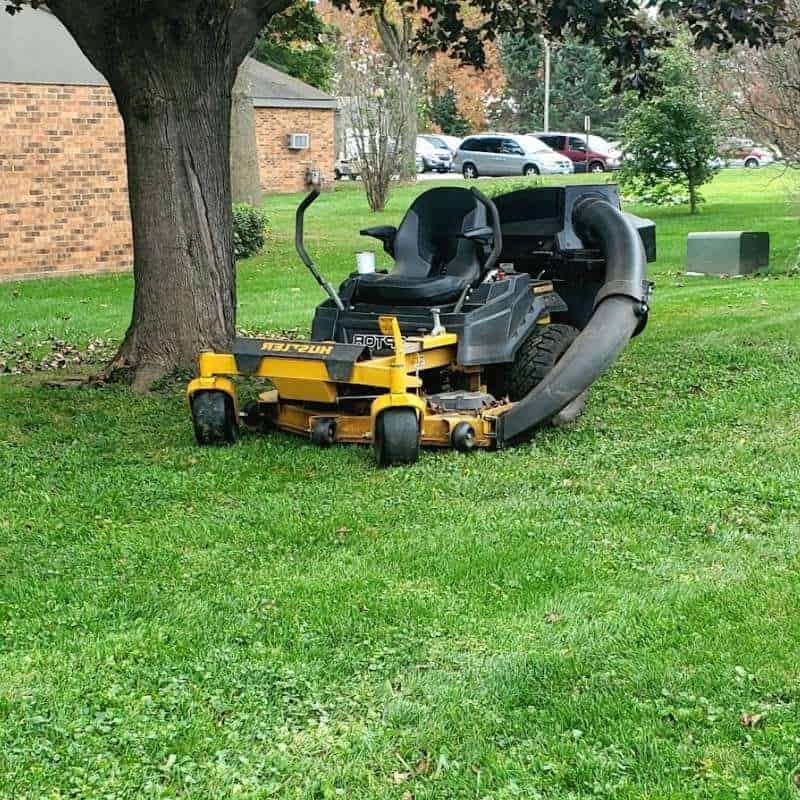
A thick, wet mat of leaves sitting under snow all winter does more damage than skipping fertilizer. Mulch light leaf cover with the mower, and rake or bag heavy piles.
Finish your last mow
Keep mowing as long as the grass is growing, and drop the height a little for the final cut so long grass doesn't mat down under the snow. Just don't scalp it.
Plan a soil test
If you've never tested your soil, it's an easy way to stop guessing. A soil test tells you whether your lawn actually needs phosphorus or potassium, and it's the only way phosphorus fertilizer is allowed on an established lawn in Minnesota. The University of Minnesota runs a soil testing lab that offers lawn and garden tests. Pulling samples is easiest once the ground thaws in spring.
Put next year's dates on the calendar
The simplest way to avoid this question next November is to plan now. A good basic schedule for most Rochester lawns:
- Spring (around Memorial Day): a lighter feeding, about one-third of the year's nitrogen. Don't jump the gun in early spring.
- Fall (around Labor Day, and no later than mid-October): the bigger feeding, about two-thirds of the year's nitrogen, split into one or two applications.
The question itself: We get the ‘is it too late?’ question every November. Usually the answer is to rake, mow, and circle Labor Day on next year’s calendar.
The Bottom Line on Lawn Fertilization in Rochester, MN
For most lawns, the useful fall fertilizer window in southeast Minnesota runs from early August through mid-October. By November, the grass is slowing down, the soil is cold, and a lot of what you spread won't get used. If we get a warm, snow-free stretch and the lawn is still green, a fast-release, phosphorus-free product watered in can still be worth it. Otherwise, rake the leaves, finish your last mow, and plan to hit the window next year.
Want Next Year's Fertilization Taken Care Of?
If you'd rather not keep track of the timing yourself, Redemptive Outdoor Services handles lawn fertilization, lawn care, and snow removal for homeowners in Rochester and the surrounding area. We quote fertilization from satellite measurements of your property, so you don't need to be home or schedule a visit.
Request a free quote whenever you're ready. No pressure, just a straight answer on what it would cost.